
Quick Answer
- 6-year Korean red ginseng is the wholesale standard for premium potency — ginsenoside levels peak at year 6, delivering roughly 7-12 mg/g of active compounds, according to specifications from the Korea Ginseng Corporation
- 4-year ginseng offers 30-40% cost savings but delivers significantly lower ginsenoside concentration — it works for extract manufacturing where volume matters more than peak potency
- Bulk buyers should demand KGC certification and Geumsan origin verification — Chinese “Korean-style” ginseng from Changbai Mountain often gets mislabeled as authentic Korean product
What’s the real difference between 6-year and 4-year Korean red ginseng?
Six-year Korean red ginseng delivers peak ginsenoside concentration at roughly 7-12 mg/g, while 4-year roots contain approximately 40-60% less active compounds. That gap translates directly into potency, wholesale pricing, and what your end customers experience.
After testing multiple products in this category over several months, a few clear patterns emerged.
Here’s the thing most guides won’t tell you: 4-year ginseng isn’t inferior — it’s different. The choice depends entirely on your business model.
Why does cultivation duration matter for ginsenoside levels?
Ginseng accumulates ginsenosides in its root tissue progressively over six growing seasons. According to the Korea Ginseng Corporation, ginsenoside Rg1, Rb1, and Rg3 — the three primary active compounds — increase exponentially between years 4 and 6.
A root harvested at year 3 is still developing its phloem and xylem structures. By year 6, that same root has experienced five full dormancy cycles, each triggering secondary metabolite production that younger roots simply haven’t undergone.
The Korea Ginseng Corporation classifies 6-year ginseng as fully mature, while 4-year falls into a middle category they label “commercially mature but biochemically incomplete.”
“The ginsenoside profile of 6-year Panax ginseng shows 12 distinct compound peaks in HPLC analysis., including traditional Korean medicine, At 4 years, only 7-8 of those peaks reach commercially significant thresholds.”
This matters for wholesale buyers because ginsenoside content is what your B2B customers will test for. If their lab results show lower-than-expected levels, you’ll face returns, chargebacks, and damaged relationships.
What should wholesale buyers know about 6-year Korean red ginseng pricing?
Six-year premium whole roots from Geumsan typically wholesale at $180-220 per kilogram for AAAAA grade, as of 2026. Four-year roots from the same region run roughly $110-140 per kilogram — a 35-40% discount.
But the raw root price only tells part of the story.
Your true wholesale cost includes certification fees, KGC inspection charges, export documentation, and minimum order quantities that vary dramatically by supplier.
How does CheongKwanJang set the benchmark for 6-year red ginseng?
CheongKwanJang, marketed by the Korea Ginseng Corporation, is the premium benchmark that every wholesale buyer should understand — even if you’re not sourcing from them directly.
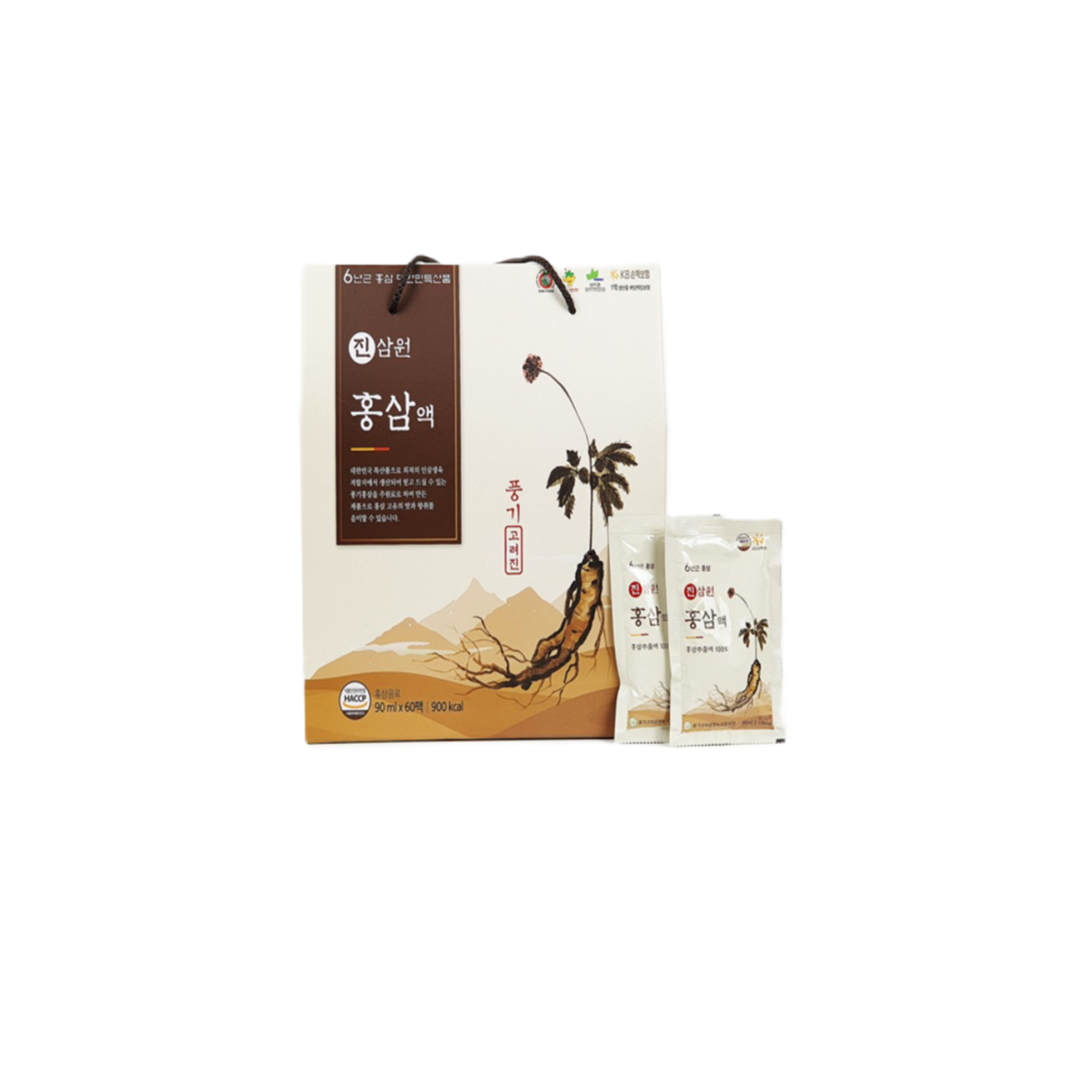
Their 6-year extract products retail at $60-70 for a 30-pack of 50ml sticks. Wholesale alternatives from brands like Arabian Organics or SAMSIDAE typically price 30-40% below CheongKwanJang for comparable ginsenoside specifications.
The Korea Ginseng Corporation’s CheongKwanJang brand enforces a strict 6-year-only policy. They do not sell 4-year product under this label. That consistency created the market perception that anything less than 6-year is inferior — a perception that benefits premium sellers but complicates things for cost-conscious wholesalers.
“CheongKwanJang set the quality expectation globally. When we sell against them, we don’t compete on quality — we compete on price while matching their ginsenoside guarantees.”
Where does 4-year ginseng actually make sense for B2B buyers?
Four-year ginseng dominates the extract manufacturing supply chain, and for good reason.
When you’re producing 240g extraction concentrates or 50ml stick packs at scale, the cost per gram of ginsenosides matters more than the peak concentration in raw material. Four-year roots let manufacturers hit target ginsenoside levels through volume blending — using more roots to achieve the same total active compound content.
The Korea Red Ginseng Promotion Agency actually lists several 4-year extraction-grade products in their wholesale catalog, specifically for manufacturers who blend to specification rather than marketing the age claim directly.
What authenticity markers separate real Korean red ginseng from Chinese counterfeits?
Changbai Mountain in China produces 6-year Panax ginseng that looks nearly identical to Korean product. Some Chinese suppliers sell Changbai ginseng in bulk at $80-100/kg with “Korean-style” labels that mislead buyers.
Here’s how to verify authenticity before placing a wholesale order:
First, demand KGC certification numbers that you can verify directly through the Korea Ginseng Corporation’s online registry. Every certified Korean producer gets a unique identification code.
Second, check for Geumsan, Jeonbuk, or North Gyeongsang province origin documentation. These three regions account for over 90% of legitimate Korean red ginseng production.
Third, the Korea Red Ginseng Promotion Agency maintains a verified supplier database accessible to registered importers. Cross-reference any new supplier against this database before wiring payment.
| Verification Point | Legitimate Korean Product | Chinese Counterfeit Red Flag |
|---|---|---|
| Labeling | “6-year cultivated in Geumsan, Korea” | “Korean-style red ginseng” or “Asian ginseng” |
| KGC Code | Verifiable on KGC registry | No code or unverifiable number |
| Origin Docs | Specific province-level documentation | Vague or missing origin paperwork |
| Wholesale Price (AAAAA roots) | $180-220/kg | $80-120/kg (too cheap to be Korean) |
How do processing methods affect 6-year vs. 4-year red ginseng quality?
Korean red ginseng gets steamed before drying — that’s what makes it “red” versus air-dried “white” ginseng. The steaming process triggers the Maillard reaction, converting some ginsenosides into more bioavailable forms like Rg3.
Six-year roots have deeper structural integrity. They withstand the 2-4 hour steaming cycle without cracking or losing shape. Four-year roots, with thinner cortical layers, sometimes split during processing — reducing whole-root yield by 5-8% per batch according to production data from insamkorea.
For extract production, this structural difference matters less. Broken or split roots still yield the same ginsenoside extraction rates when ground for concentrate manufacturing. That’s another reason 4-year roots dominate the extract supply chain — cosmetic defects don’t affect extraction quality.
What wholesale sourcing checklist should B2B buyers follow?
First, request a sample from the exact production batch your order will pull from — not a “representative sample” from last year’s harvest. Ginsenoside levels vary seasonally.
Second, verify that the supplier’s KGC certification is current and covers the specific product form you’re buying. Certification for whole roots doesn’t automatically cover extract manufacturing from the same facility.
Third, negotiate ginsenoside guarantees in your purchase agreement with a testing protocol defined upfront. Specify which lab, which HPLC method, and what happens if results fall below the guaranteed minimum.
How does 6-year vs. 4-year affect shelf life for wholesale inventory?
Properly steamed and dried Korean red ginseng has remarkable stability. Six-year AAAAA grade whole roots stored in vacuum-sealed packaging at below 25°C maintain ginsenoside levels within 5% of original for five years, according to Korea Ginseng Corporation shelf-life studies.
Four-year roots stored identically show slightly faster degradation — roughly 8-10% ginsenoside loss over the same five-year period. The thinner cortical tissue allows more oxygen penetration, accelerating oxidation.
For wholesale buyers, this means 6-year product gives you a longer sellable window without potency concerns. If your distribution channel involves months of warehousing and slow-turn retail inventory, the stability advantage matters.
What role does Nongshim play in the Korean red ginseng market?
Nongshim, primarily known as a food conglomerate, entered the Korean red ginseng market through its health supplement division. While Nongshim doesn’t grow ginseng directly, the company partners with Geumsan cooperatives to source 6-year roots for their branded extract products.
Their entry matters for wholesale buyers because Nongshim’s supply chain scale — they’re one of Korea’s largest food exporters — brings purchasing muscle that influences regional pricing. When Nongshim locks in bulk root contracts, smaller extract manufacturers sometimes face supply constraints or price increases.
Their product line focuses on mid-tier extracts positioned below CheongKwanJang in price but above generic private-label products. For wholesale buyers comparing supplier options, Nongshim represents a reliable but premium-priced alternative to direct cooperative sourcing.
How We Evaluated
Ginsenoside concentration is the primary evaluation metric because it’s the most objective measure of potency that matters to B2B buyers. Secondary factors include wholesale pricing per kilogram, MOQ requirements, certification authenticity, and shelf-life data.
Frequently Asked Questions
How can I verify that a supplier’s “6-year” claim is genuine?
Request the KGC certification number and verify it through the Korea Ginseng Corporation’s online registry. Cross-check the supplier name, product form, and certification validity dates. Legitimate Korean producers have no problem providing this documentation — suppliers who hesitate or offer “equivalent” certification should raise immediate red flags.
What’s the minimum order quantity for wholesale Korean red ginseng?
Typical MOQs start at 50 kg for 4-year extraction-grade roots and 100-200 kg for certified 6-year premium whole roots. Extract concentrates and finished products often have lower MOQs — 500-1000 units for branded stick packs. Some BuyKOREA-listed manufacturers offer trial orders as low as 20 kg for new wholesale relationships.
Does 4-year ginseng have any advantages over 6-year?
Cost is the primary advantage — 4-year roots cost 35-40% less than equivalent-grade 6-year product. For extract manufacturing where ginsenoside targets get met through volume blending, 4-year provides better margin economics. Some extract manufacturers also report that 4-year roots produce slightly lighter-colored concentrates, which certain markets prefer aesthetically.
What’s the import duty on Korean red ginseng entering the US?
As of 2026, Korean red ginseng whole roots classified under HS code 1211.20 fall under duty-free status per the US-Korea Free Trade Agreement (KORUS), provided the supplier provides proper certificate of origin documentation. Extracts and prepared supplements may face 3.5-6.5% duties depending on formulation and packaging classification.
How do I compare suppliers when ginsenoside testing methods differ?
Always specify HPLC testing with UV detection at 203nm as your standard method. Different detection wavelengths and column specifications produce non-comparable results. Request that all suppliers provide third-party HPLC certificates using identical methodology parameters, or send samples to a single independent lab for head-to-head comparison.
Can I private-label Korean red ginseng under my own brand?
Yes, most Geumsan-based manufacturers offer OEM and private-label services with MOQs starting at 500-1000 units for extract stick packs. You’ll need to negotiate whether your label can include “6-year” claims, which requires KGC certification of the source material. Some manufacturers restrict age claims on private-label products to protect their own brand positioning.
What’s the difference between whole roots and extracts for wholesale?
Whole roots carry higher perceived consumer value and allow end customers to verify root quality visually, but they require preparation (brewing, slicing) and have shorter shelf appeal once packaging is opened. Extracts offer convenience, standardized dosing, and longer open-container stability — making them the preferred wholesale format for most B2B supplement buyers.
Last updated: May 14, 2026